When handling loads, choosing the right lifting sling involves more than checking its capacity. Its shape, construction, and how it fits around the load also influence the selection.
Flat webbing slings and round slings are used in a variety of industrial, marine, and offshore applications. Although both can be manufactured from high-tenacity polyester, their different constructions help determine when each solution may be suitable.
What Is the Difference Between a Flat Webbing Sling and a Round Sling?
The main difference lies in the structure of the textile body.
Flat Webbing Sling: A Wider Contact Surface
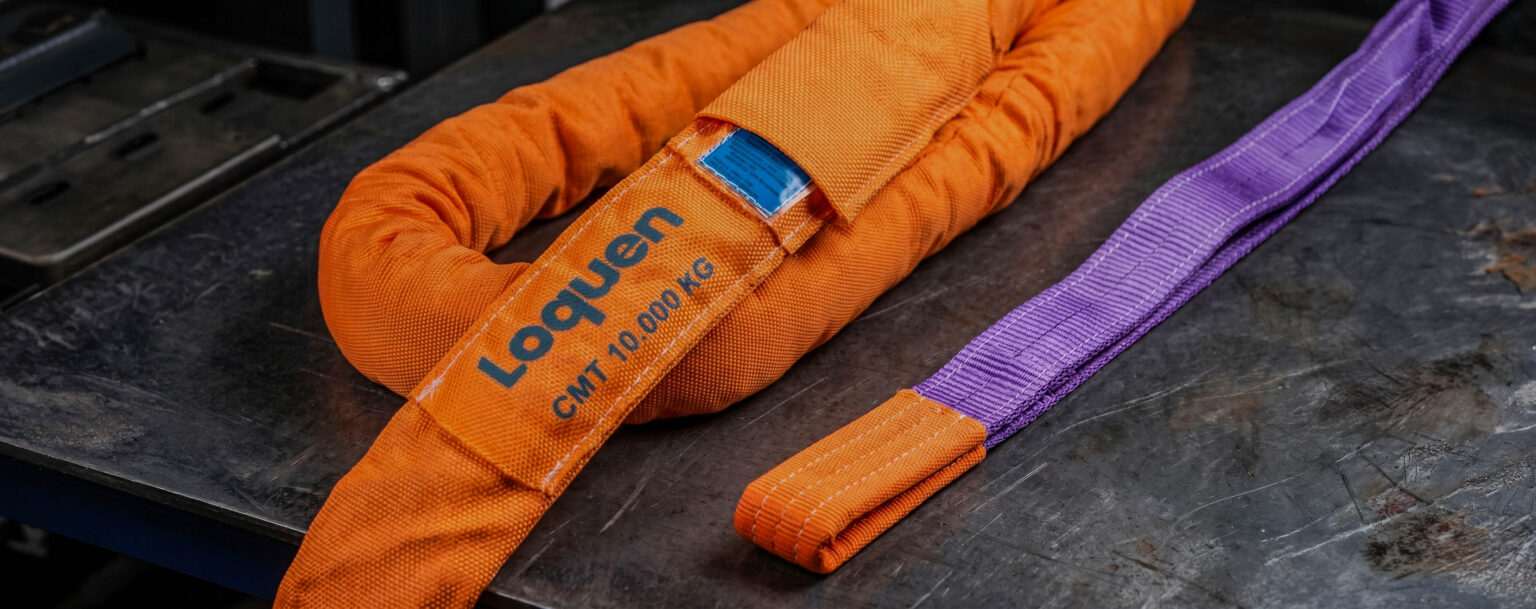
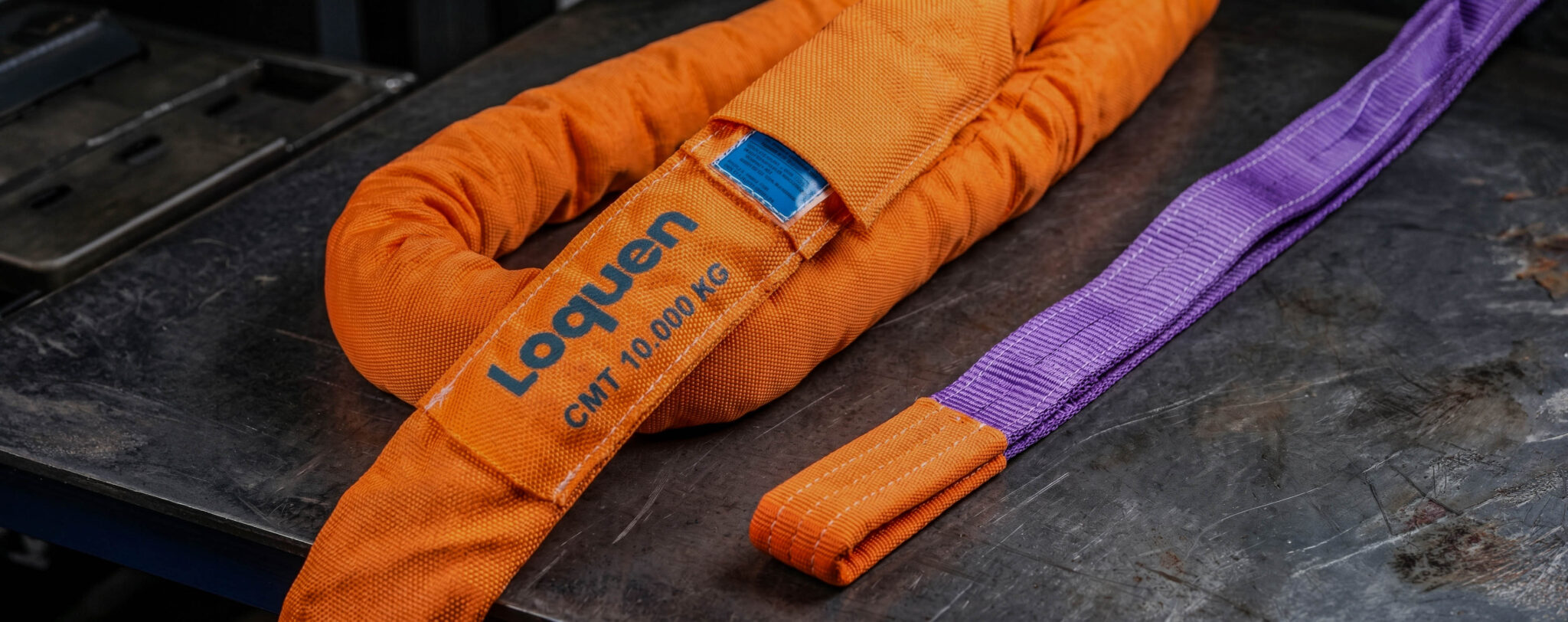
A flat webbing sling is manufactured in the form of a strap with a defined width. Its construction provides a wider contact surface when properly positioned on the load.
The Loquen LQS is manufactured from 100% high-tenacity polyester. This type of sling may be suitable for handling structures, equipment, and industrial components whose surfaces allow proper support.
Despite its wider contact area, sharp edges, burrs, and abrasive surfaces must be assessed, as they can damage the webbing. The sling must also remain correctly positioned, without twists or folds.
Round Sling: Flexibility for Different Geometries
A round sling features an internal core of high-strength yarns protected by a tubular textile cover. This construction allows the sling body to conform to different load shapes.
The Loquen LQRD features a core made of high-tenacity polyester yarns, protected by a double tubular cover with a side seam. The product line includes endless and eye-type configurations.
Its flexibility can be useful when handling pipes, cylindrical components, and other equipment with irregular geometries. However, conforming to a load’s shape does not guarantee stability. Sling positioning and the risk of slipping must be assessed before lifting.
Because the load-bearing core is protected by the cover, any cuts, abrasion, or damage to this cover must be addressed according to the manufacturer’s inspection criteria.
How to Choose the Right Sling for Each Application
Load geometry is a good starting point, but it should not be the only selection criterion.
For structures with flat surfaces, a flat webbing sling may provide a suitable contact area. For curved or cylindrical loads, the flexibility of a round sling may make positioning easier.
However, this distinction alone does not determine which sling should be used. In both cases, the following factors must be assessed:
- Load weight and center of gravity: Help determine the lifting points and load distribution.
- Lifting configuration: Vertical, basket, or choker hitches may result in different permissible capacities.
- Load surface: Sharp edges, abrasion, and crushing points can compromise the sling, making suitable protection necessary.
- Accessories used: Hooks, shackles, and other components must provide compatible support without creating compression points or concentrated stresses.
- Environmental conditions: Temperature, chemicals, UV exposure, and other service conditions must remain within the limits specified by the manufacturer.
In offshore operations, these checks are particularly important to ensure that the selected solution is compatible with actual working conditions.
Lifting Configuration Also Affects Capacity
A sling does not necessarily have the same capacity in every configuration.
In a vertical hitch, the load is supported directly by the sling. In a basket hitch, the sling passes underneath the load, while in a choker hitch, it wraps around the load and tightens as the load is lifted.
Each arrangement has its own operating conditions. The Working Load Limit (WLL) must be checked on the product identification label and in the technical documentation for the specific model, taking the intended configuration into account.
When two or more sling legs are used, the angles also influence the forces acting on each leg. Equal load distribution should not be assumed: the load geometry, center of gravity, and arrangement of the lifting points can result in different forces.
Therefore, sling selection must consider not only the total load weight but also how that weight will be supported.
Inspection: What to Check Before Use
Before each use, the sling must be inspected in accordance with applicable procedures and the manufacturer’s instructions.
For flat webbing slings, check for cuts, wear, edge damage, compromised stitching, and signs of exposure to heat or chemicals. For round slings, also check for punctures, abrasion, and cover damage that could compromise protection of the internal core.
The identification label must be legible to confirm the sling’s capacity and conditions of use. Damaged slings, slings without adequate identification, or those whose integrity is in doubt must be removed from service and assessed according to the applicable criteria.
Loquen Solutions for Load Handling
The Loquen product line includes textile slings with different constructions to meet a range of lifting requirements:
- Loquen LQS features a flat webbing construction made from 100% high-tenacity polyester. Selection must take into account the model’s dimensions, configuration, and the capacity required for the application.
- Loquen LQRD features a core of high-tenacity polyester yarns and a double tubular cover, with endless and eye-type configurations. The product line includes rated capacities from 1 to 100 tonnes in the vertical configuration.
For both models, the applicable capacity and operating limitations must be confirmed in the technical documentation for the selected product reference.
The Right Choice Starts with the Application
A flat webbing sling features a strap-like construction, while a round sling uses a core of yarns protected by a tubular cover. These differences influence contact with the load and positioning options, but they do not, on their own, determine which solution is most suitable.
Load type, lifting configuration, sling angles, and operating conditions should guide the selection.
Explore Loquen’s load-handling solutions and contact our team to identify the sling best suited to your operational requirements.