Technical specifications, effective load capacity calculations, and safe application of synthetic lifting slings.
In lifting and load-handling operations across industry, construction, and the offshore sector, quickly and accurately identifying equipment load capacity is essential to operational safety. To standardize and simplify this identification in day-to-day operations, the Brazilian standard established an international color code for synthetic textile slings.
This article explains how the color code works, how to calculate load capacity for different hitch configurations, the specifications of Loquen® slings (LQS and LQRD), the three parts of ABNT NBR 15637, and the risks of improperly using white disposable slings in reusable lifting operations.
1. Color Code and Rated Capacities (CMT)
The standardized color code refers to the sling’s nominal Maximum Working Load (CMT) in the vertical hitch (straight pull / 0°). Under ABNT NBR 15637, sling colors for capacities from 1 t to 8 t are standardized as follows:
| Sling Color | Maximum Working Load (CMT) – Vertical |
| Purple | 1.0 tonne (1,000 kgf) |
| Green | 2.0 tonnes (2,000 kgf) |
| Yellow | 3.0 tonnes (3,000 kgf) |
| Gray | 4.0 tonnes (4,000 kgf) |
| Red | 5.0 tonnes (5,000 kgf) |
| Brown | 6.0 tonnes (6,000 kgf) |
| Blue | 8.0 tonnes (8,000 kgf) |
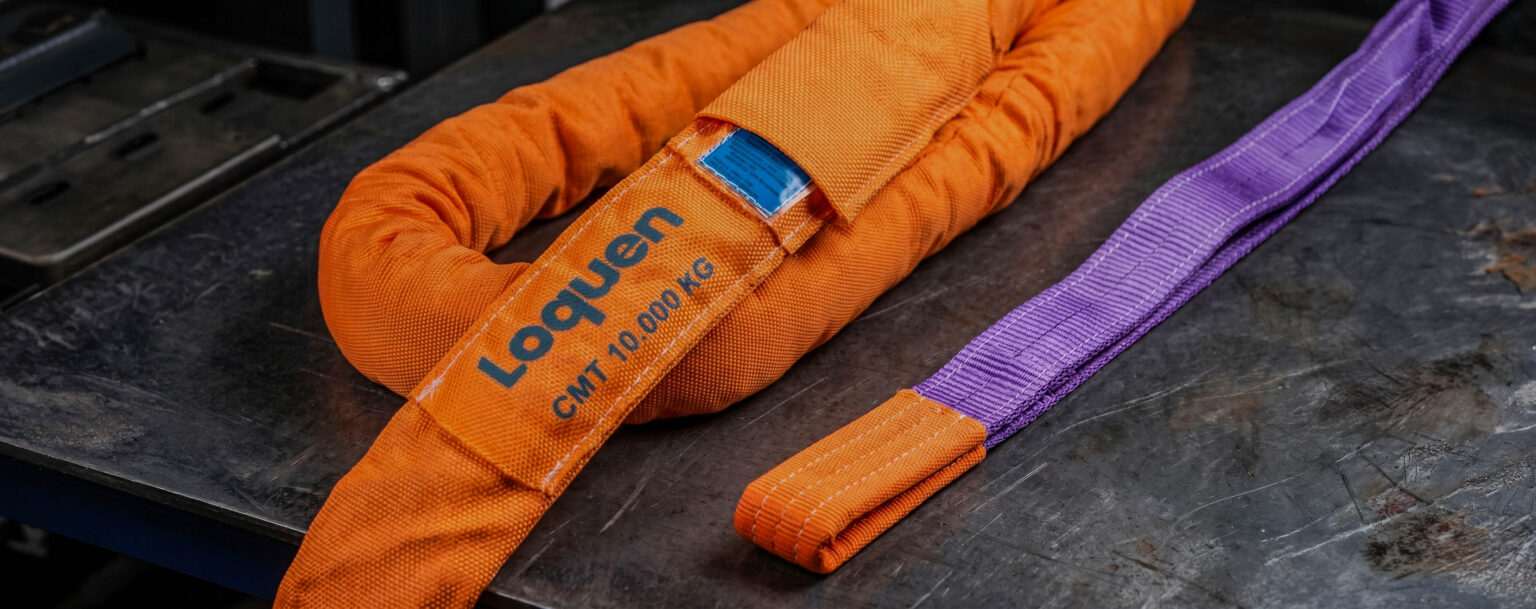
| Orange | 10.0 tonnes (10,000 kgf) and above (e.g., 12 t, 15 t, 20 t, 30 t, 50 t, 100 t) |
| Technical Note on the Standard: The standard specifies colors for capacities from 1,000 kgf to 8,000 kgf. From 10,000 kgf (10 tonnes) onward, all high-capacity slings must be identified in orange. |
2. Usage Factors (FU) and Variation in Effective Load Capacity (CMTE)
A sling’s effective working load capacity (CMTE) varies according to the hitch configuration and the working angle relative to the vertical. To determine the maximum load permitted for the operation, multiply the CMT by the Usage Factor (FU):
Calculation Formula: CMTE = CMT × FU
- Vertical (Straight Pull – 0°): Usage factor 1.0 (supports 100% of the CMT).
- Choker Hitch (0°): Usage factor 0.8 (20% reduction in capacity; supports 80% of the CMT).
- Simple Basket Hitch (0° / parallel): Usage factor 2.0 (doubles capacity; supports 200% of the CMT).
- Angled Basket Hitch (45°): Usage factor 1.4 (supports 140% of the CMT).
- Angled Basket Hitch (60°): Usage factor 1.0 (supports 100% of the CMT).
| Critical Safety Warning: Using slings or sling assemblies at working angles greater than 60° from the vertical is strictly prohibited. |
3. Loquen® Lifting Slings: Product Range
Loquen offers textile lifting solutions made from 100% high-tenacity polyester (PES), designed for durability and safety.
Loquen® LQS Flat Webbing Sling (with Reinforced Eyes)
- Construction: Flat woven webbing made from synthetic polyester multifilament yarns, with reinforced eyes at both ends.
- Reference Standard: ABNT NBR 15637-1.
- Applications: Provides stable support for flat surfaces, structures, and industrial equipment whose geometry allows the webbing to sit evenly along the contact area.
- Capacities: Available from 1 to 10 tonnes in a vertical lift, in accordance with the standard color code.
Loquen® LQRD Tubular / Round Sling
- Construction: A continuous core made of bundles of high-tenacity polyester yarns, protected by a double tubular cover with a side seam.
- Reference Standard: ABNT NBR 15637-2.
- Models: LQRD Endless (allows the contact points to rotate continuously) and LQRDO / LQRD with eyes.
- Applications: Excellent flexibility for conforming to cylindrical items (pipes, shafts) and loads with irregular geometries.
- High-Capacity Range: Rated capacity from 1 to 100 tonnes in a vertical lift.
4. Summary of ABNT NBR 15637 Technical Standards
The Brazilian ABNT NBR 15637 series establishes requirements for the manufacture, testing, inspection, and safe use of textile lifting slings in Brazil:
ABNT NBR 15637-1: Manufactured Flat Webbing Slings
Covers flat lifting slings made from woven webbing produced with high-tenacity synthetic multifilament yarns.
- Safety Factor (FS): Requires a minimum safety factor of 7:1 for slings without fittings and 4:1 for slings assembled with metal fittings (sling assemblies).
ABNT NBR 15637-2: Manufactured Tubular Slings (Roundslings)
Specifies technical requirements and test methods for tubular (round) slings made from high-tenacity synthetic multifilament yarns.
- Safety Factor (FS): Specifies a minimum safety factor of 7:1 for the sling without fittings and at least 4:1 for assemblies with fittings.
- Protective Covers: The outer cover does not have a structural load-bearing function. It serves only to enclose and contain the core and protect it from abrasion and dirt.
ABNT NBR 15637-3: Ultra-High-Tenacity Tubular Slings
Covers tubular slings made from ultra-high-tenacity synthetic yarns (such as UHMWPE/HMPE fibers).
- Safety Factor (FS): Given the advanced properties of ultra-high-tenacity fibers, the standard sets a minimum safety factor of 5:1 without fittings and 4:1 with fittings.
Note: Choosing between a conventional high-tenacity sling identified by the color orange and an ultra-high-tenacity round sling depends on the requirements of the operation, not solely on load capacity. Orange identifies slings with a nominal Maximum Working Load (CMT) of 10 tonnes and above, without setting an upper capacity limit. Ultra-high-tenacity slings specified under ABNT NBR 15637-3 can offer advantages in heavy lifting operations, particularly when made from HMPE fibers, which combine high mechanical strength, low self-weight, and low elongation. These properties can make high-capacity slings easier to handle, reduce the weight of the lifting assembly, and provide greater control over load movement. Therefore, even when both types meet the required load capacity, selection should also take into account the sling’s weight and dimensions, allowable elongation, rigging configuration, and the requirements of the lift plan, in accordance with the manufacturer’s specifications.
Important technical point: 40 tonnes should not be treated as a universal threshold above which an ultra-high-tenacity sling must be used. HMPE models with rated capacities ranging from 10 to 100 tonnes are commercially available, while conventional slings can also achieve high capacities. The key difference lies in the material properties and the requirements of the application, not in a fixed tonnage threshold.
5. Why White Slings Should Not Be Used in Reusable Operations
In industrial settings, white textile slings are common; however, using them in ongoing load-handling operations presents a serious safety risk and is contrary to Brazilian standards for several technical reasons:
- 1. Explicit Exclusion from ABNT NBR 15637: The standard clearly states within its scope that its guidelines, specifications, and approvals do not apply to slings designed for non-reusable (disposable) use.
- 2. Not Included in the Standardized Color Code: The Brazilian and international color code standardizes capacities from 1 t to 8 t (purple, green, yellow, gray, red, brown, and blue) and reserves orange for 10 t and above. White is not part of the standardized capacity color code for reusable lifting slings.
- 3. Single-Use Design (One-Way / Disposable): White slings are designed for one-way transport applications (such as moving a load once from a factory for onward logistics transport). Once the load reaches its final destination, the slings must be cut and discarded.
- 4. Safety Factors Not Suitable for Reuse: While reusable industrial slings (such as Loquen® slings) are designed with stringent safety factors of 7:1 (or 5:1 for ultra-high-tenacity slings) and carry traceable identification labels, white disposable slings are not guaranteed to withstand repeated cycles of fatigue, abrasion, and periodic inspection.
For these reasons, only textile slings compliant with and certified to ABNT NBR 15637, such as the Loquen® LQS and LQRD product lines, should be used in ongoing lifting and rigging operations.
| Talk to Loquen® Specialists: Contact Loquen’s technical team to request our full catalog and specify the ideal LQS or LQRD sling for your operation! |